Ventura Coastal Duplex Investment Guide for Buyers
June 25, 2026
June 25, 2026
Wondering whether a Ventura coastal duplex or fourplex is a smart investment, or just an expensive beachside bet? If you are looking at small multifamily near the coast, you are probably weighing rental demand, upkeep, tax exposure, and the realities of owning an older property in a regulated coastal setting. This guide will help you understand what makes Ventura’s duplexes and fourplexes appealing, what can affect returns, and what to verify before you buy. Let’s dive in.
Ventura offers something many small multifamily investors want but do not often find in one place: a coastal setting, a working local economy, and year-round lifestyle appeal. The City of Ventura highlights destinations like Surfers’ Point, Ventura Pier, Ventura Harbor, and Channel Islands access as central parts of the city’s identity.
That setting can support renter interest from more than one angle. Ventura also reports more than 12,000 businesses and a workforce of more than 53,000, with healthcare and public administration among the leading sectors. For you as an investor, that means coastal duplexes and fourplexes may appeal to both lifestyle-oriented renters and local workforce households.
The broader numbers reinforce that Ventura is a high-cost housing market. Census QuickFacts lists Ventura at 109,914 residents in 2025, with 41,858 households, a median household income of $103,069, a median value of owner-occupied homes of $827,300, and a median gross rent of $2,198. HUD’s FY2026 fair market rents for the Oxnard-Thousand Oaks-Ventura area range from $1,998 for a studio to $4,240 for a four-bedroom unit, which helps show the strength of the rental market, even though fair market rent is not the same as asking rent.
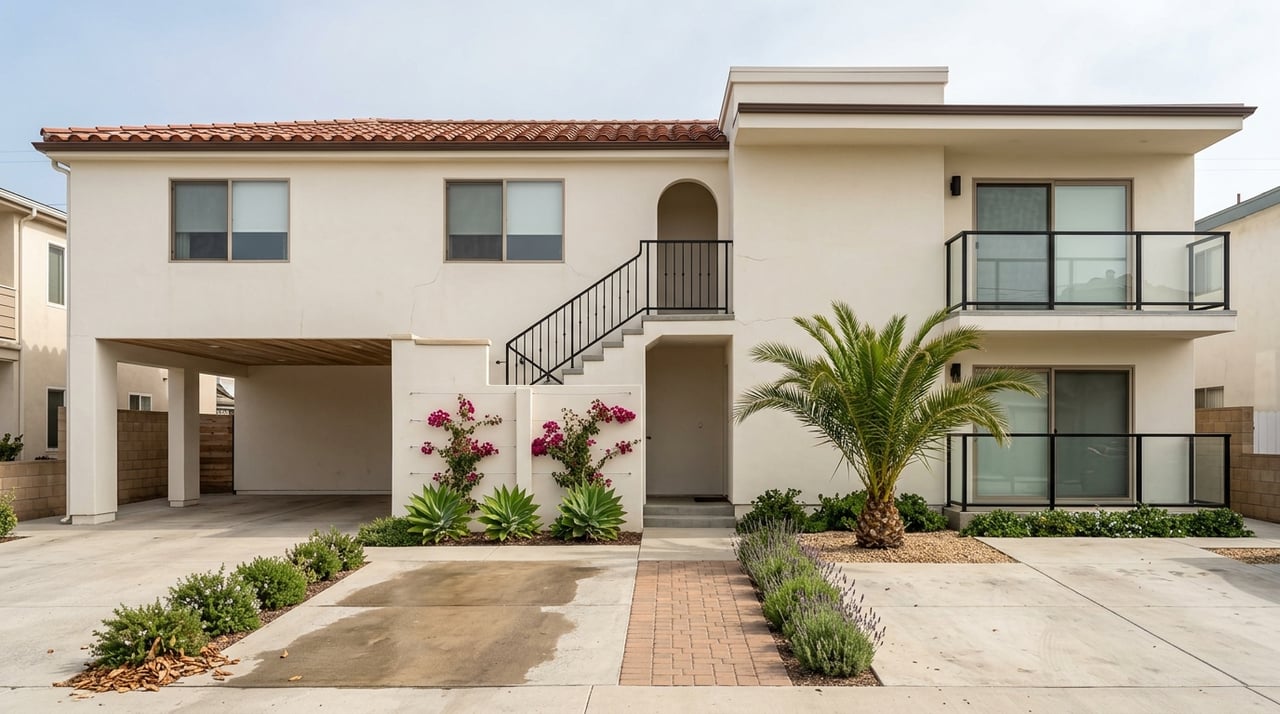
Ventura coastal duplexes and fourplexes often differ from the larger apartment product many investors picture first. In this market, the small multifamily story is often about compact buildings, older construction, and very site-specific layouts rather than large, uniform complexes.
That is especially true in Pierpont Bay. Ventura’s 2024 historic resource survey identifies Pierpont Bay as the city’s only beachfront residential neighborhood, and it documents early examples of courtyard apartments, duplexes, and duplex, triplex, and fourplex properties dating back to the late 1920s and early 1930s.
The same survey notes a pattern of pedestrian courts and car-friendly lanes extending back from Shore Drive along the beachfront. It also describes modest beach cottages and some courtyard apartments as part of the original development pattern. For you, that can translate into a building stock that feels distinctive and desirable, but also older and less standardized.
If you are comparing properties, layout matters because it affects privacy, parking, curb appeal, and rentability. Ventura’s public draft overlay standards treat duplex, triplex, and quadplex housing as either stacked flats or side-by-side flats.
Those standards also emphasize street-oriented entries, limits on where parking can be placed, and usable private or common open space. Even if a property predates current planning drafts, these guidelines help you understand the city’s design direction and what may matter if you renovate or reposition an asset.
In practical terms, many investors in Ventura’s coastal areas should expect the following features:
That mix can be attractive to renters who value location and character, but it also means due diligence should go beyond surface-level upgrades.
A coastal location alone does not make a property perform, but Ventura does have several demand drivers working together. The combination of beach access, harbor amenities, employment base, and relatively high local housing costs can help support ongoing renter demand for smaller multifamily properties.
Ventura Harbor Village adds to that appeal with waterfront shops, restaurants, events, harbor boat tours, and a promenade between the boats and the beach. The city also identifies two beach areas, from Ventura Pier to Surfers Point and from Marina Park to Camden Lane, which helps show how much of Ventura’s identity is tied to the coast.
For many renters, that translates into a lifestyle premium. For many investors, it means a well-located duplex or fourplex may have strong appeal even when the building itself is modest. Still, demand is only part of the picture, and your actual returns depend on acquisition price, expenses, condition, and management.
One of the biggest mistakes investors make is focusing too much on rent potential and not enough on post-close costs. In Ventura County, property taxes follow California rules that can materially affect your underwriting after a purchase.
According to the Ventura County Treasurer-Tax Collector, assessed value is generally based on the cash or market value at purchase. Proposition 13 limits annual assessed-value increases to 2% until a sale or new construction triggers reassessment, and the general tax levy is limited to $1 per $100 of assessed value before voter-approved special taxes and district assessments.
The practical takeaway is simple: a coastal duplex or fourplex may look appealing on income, but your tax basis after purchase may be very different from the seller’s current tax bill. If you are planning renovations or additions, you should also think carefully about how new construction may affect your cost structure.
If you are buying near the coast, permitting should be part of your investment analysis from day one. The City of Ventura says any development in the Coastal Zone must be reviewed to determine whether a Coastal Development Permit is required.
That matters because value-add strategies often depend on changes such as remodels, additions, exterior work, or new units. If coastal review applies, your project timeline may involve added approval time, more documentation, and higher soft costs.
Ventura is also updating its Local Coastal Program to address sea level rise and other coastal hazards while protecting beaches, habitat, and public access. That does not mean every coastal investment is risky, but it does mean you should underwrite with realistic reserves for inspections, permitting, insurance, and ongoing maintenance.
For some investors, an accessory dwelling unit can create another path to income growth. Ventura’s ADU guidance says that on multifamily properties, an owner may add ADUs equal to up to 25% of the existing units, one ADU in an existing non-livable structure, or up to two detached ADUs in new detached structures.
That makes ADU potential worth exploring when you review a duplex or fourplex. In the right situation, added units may improve long-term revenue and make a smaller asset more flexible.
There is an important catch in coastal areas. The city also notes that ADU work in the Coastal Zone may require an Administrative Coastal Development Permit. So if your investment plan depends on expansion, you will want to verify both physical feasibility and approval requirements before assuming future upside.
Older small multifamily can offer location, character, and income potential, but it can also hide costly surprises. In Ventura, that risk is especially relevant for coastal duplexes and fourplexes where age, weather exposure, and undocumented past work may all affect value.
The City of Ventura’s Code Enforcement Division addresses substandard buildings, property maintenance, land-use violations, and related issues. The city’s Permit Center can help with permit-history searches, building-record disclosure reports, and copies of building plans.
Before you buy, it is smart to verify:
These checks can help you avoid overpaying for unverified improvements or underestimating future costs.
In Ventura’s coastal small multifamily segment, good management is not just about collecting rent. It can play a real role in protecting income and reducing operational surprises.
That is especially true when a property has older systems, deferred maintenance, or a future improvement plan. Strong day-to-day oversight can help with tenant screening, rent collection, maintenance coordination, permit tracking, and code-compliance follow-through.
For an investor who wants a more hands-off ownership experience, this matters. It can also be the difference between a property that steadily performs and one that becomes a drain on time and reserves.
The strongest Ventura coastal duplex and fourplex opportunities usually combine location with disciplined underwriting. You are not just buying proximity to the beach. You are buying a specific building, on a specific site, with a specific regulatory and maintenance profile.
In many cases, the best opportunities are lifestyle-driven income assets. The coast and harbor setting may support rentability, but the real investment case often comes down to tax planning, realistic maintenance budgets, permit awareness, and dependable management.
If you keep those factors in focus, Ventura can offer compelling small multifamily opportunities for investors who value both income and long-term coastal ownership.
If you are evaluating a Ventura coastal duplex or fourplex and want local guidance grounded in real neighborhood experience, Stark Realty Inc. can help you assess the property, the location, and the operational realities that shape long-term performance.
Stay up to date on the latest real estate trends.




Stark Realty Inc. offers Oxnard and Ventura coastal expertise, decades of local service, and comprehensive support—homes, rentals, land, and auctions. Let them guide your real estate journey with integrity, knowledge, and community-centered care.